Interior Designer vs Contractor in Singapore

An interior designer (ID) typically designs and project-manages the whole renovation for a single, usually higher fee; a contractor executes the works you specify, often for less, but more coordination falls on you. For an HDB flat, the contractor that carries out the works must be listed in HDB's Directory of Renovation Contractors.
“Should I hire an interior designer or a contractor?” really asks a different question: how much coordination do you want to pay someone else to do? Both can deliver the same physical renovation. The difference is design input and project management.
What each one does
- Interior designer (ID) firm. An ID-led package typically includes design (layout, materials, 3D visuals) plus project management — hiring and sequencing the carpenters, tilers, electricians and painters, and giving you a single point of contact. You pay for that design and coordination, so an ID package usually costs more.
- Contractor. A contractor-led package executes a defined scope of works and may provide less design input, though the contractor can still coordinate the trades within its contracted scope. A contractor-only quotation may be lower when it excludes design and broader project management — but check exactly who is responsible for drawings, submissions, procurement, scheduling, supervision and rectification.
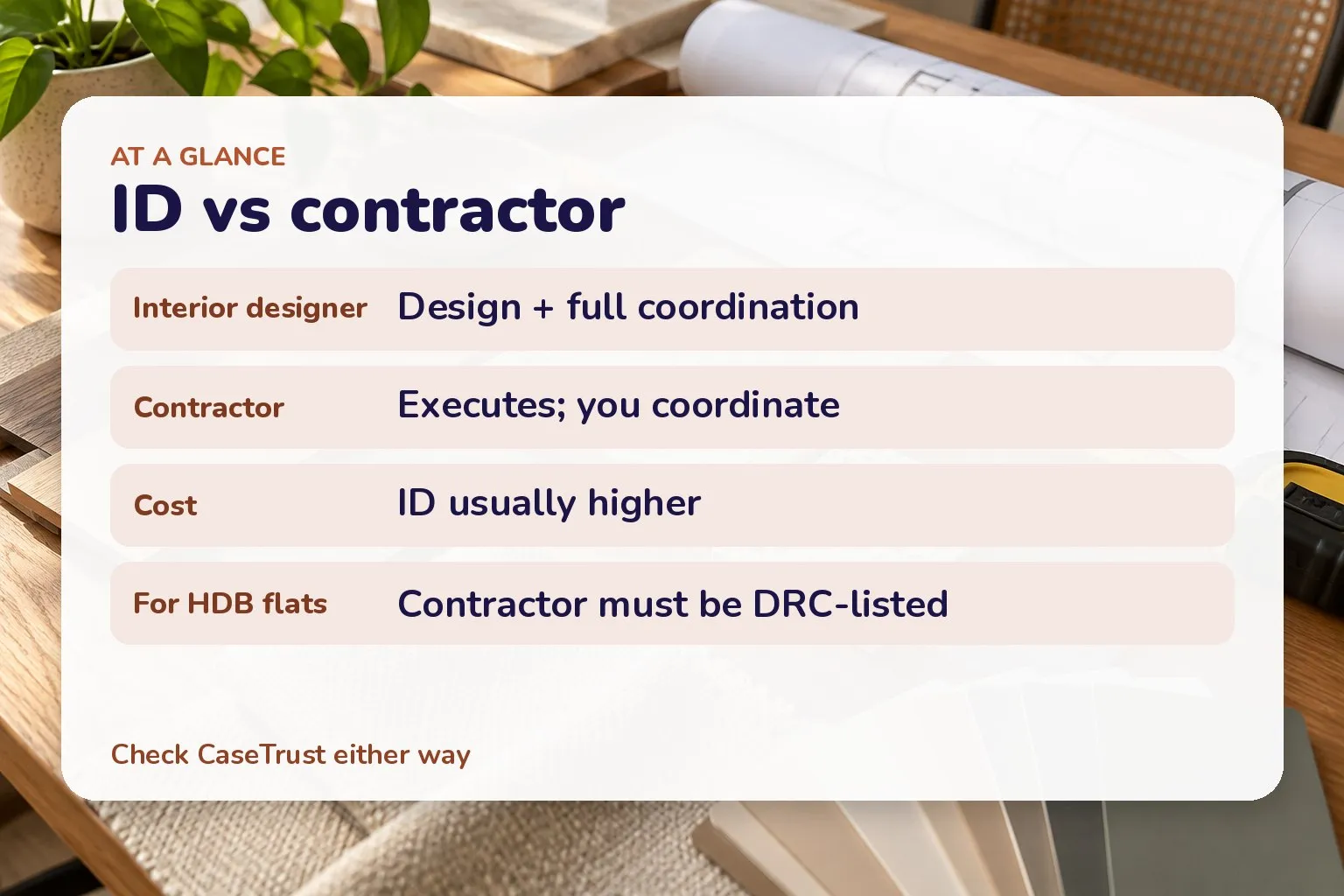
The core trade-off between an ID firm and a contractor.
For an HDB flat, the label does not change the law: the contractor that undertakes the renovation works must be listed in HDB’s Directory of Renovation Contractors (DRC) — if your ID firm is the contracting entity, verify that legal entity is DRC-listed — and the work must follow the HDB renovation rules. Compare quotations on a like-for-like scope — materials, provisional sums, exclusions and variation rates — rather than on the headline total alone.
When each makes sense
Choose an ID if you want a cohesive, designed result, have limited time, and value a single accountable party. The premium buys coordination and fewer decisions on your plate.
Choose a contractor if you already have a clear plan (or a separate designer), you are comfortable making material and sequencing decisions, and you want to keep costs down. It rewards homeowners who can project-manage.
Either way, the cost gap is real but not fixed — an ID’s coordination can prevent expensive mistakes, while a contractor route only saves money if you actually manage it well. See the HDB renovation cost guide for what the works themselves cost.
The thing that matters more than the label
Whichever you pick, protection comes from accreditation, not job title. CaseTrust-accredited renovation businesses must use a standard renovation contract, collect payments progressively, and carry a deposit performance bond. That protection is subject to the bond and contract terms and is not a guarantee of workmanship — so confirm that the exact legal entity on your contract holds current accreditation, and obtain proof that your payment is protected. It matters more to your money than whether the firm calls itself an ID or a contractor — see how to choose a renovation firm.
Related
General information only. We do not recommend specific firms; verify accreditation and listings yourself before signing.
Sources
- CaseTrust Accreditation for Renovation Businesses — Consumers Association of Singapore (CASE) (as of October 2026)
- Directory of Renovation Contractors (DRC) — Housing & Development Board (HDB) (as of October 2026)