HDB Renovation Permit: What You Need to Know
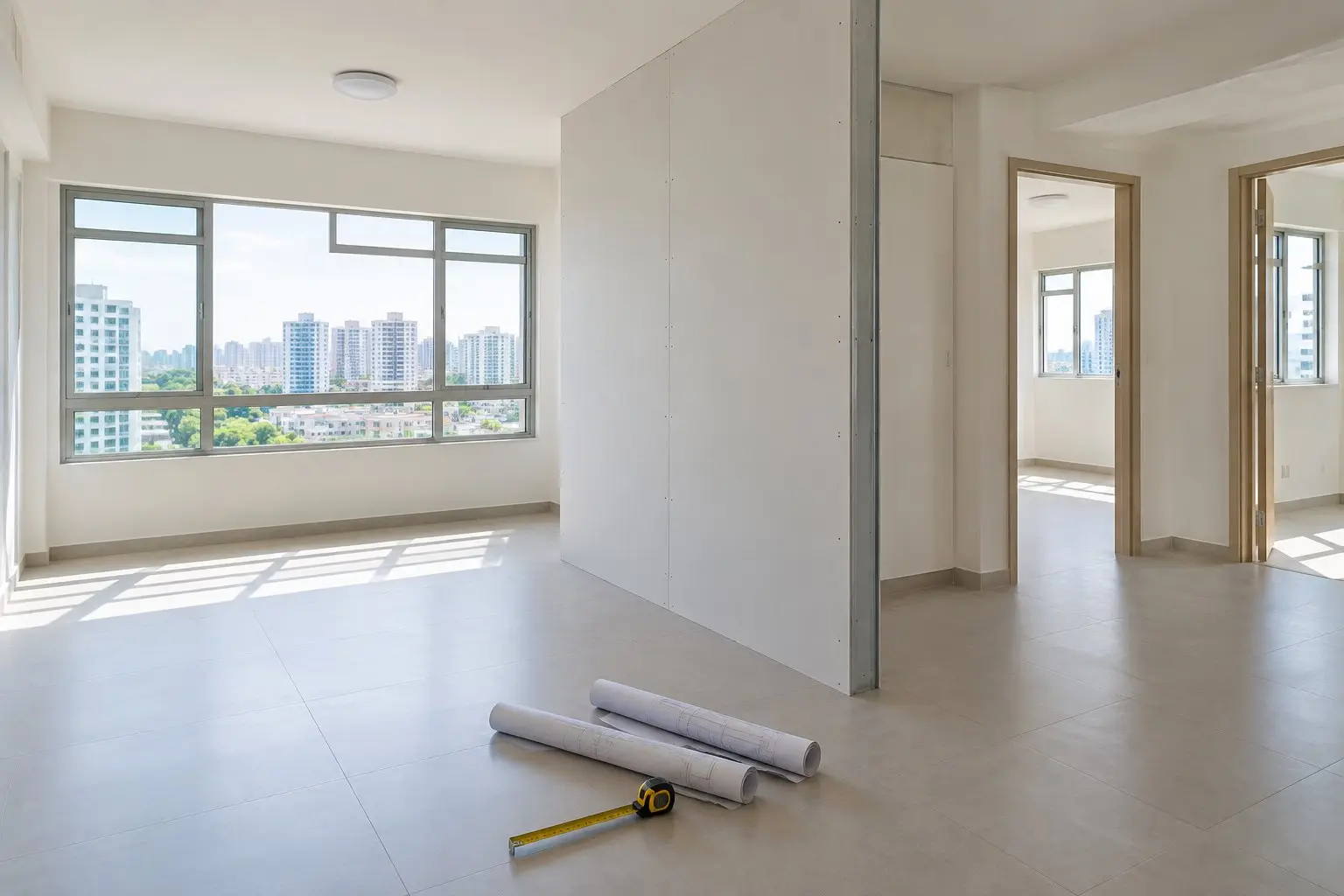
In an HDB flat you must hire a contractor from HDB's Directory of Renovation Contractors (DRC) even for works that need no permit. A permit is required before any wall demolition or hacking, replacing wall finishes to ceiling height, and enlarging a bathroom; your contractor applies to HDB for it.
Two rules sit behind every HDB renovation. First, under the Housing & Development (Renovation Control) Rules 2006, you must engage a contractor listed in HDB’s Directory of Renovation Contractors (DRC) — even for works that need no permit. Second, certain works need HDB’s prior written approval (a permit) before they start. Your contractor normally applies for the permit on your behalf; you remain responsible for keeping the whole job within the rules.
What needs a permit
HDB’s building-works guidelines set out what requires approval. In broad terms:
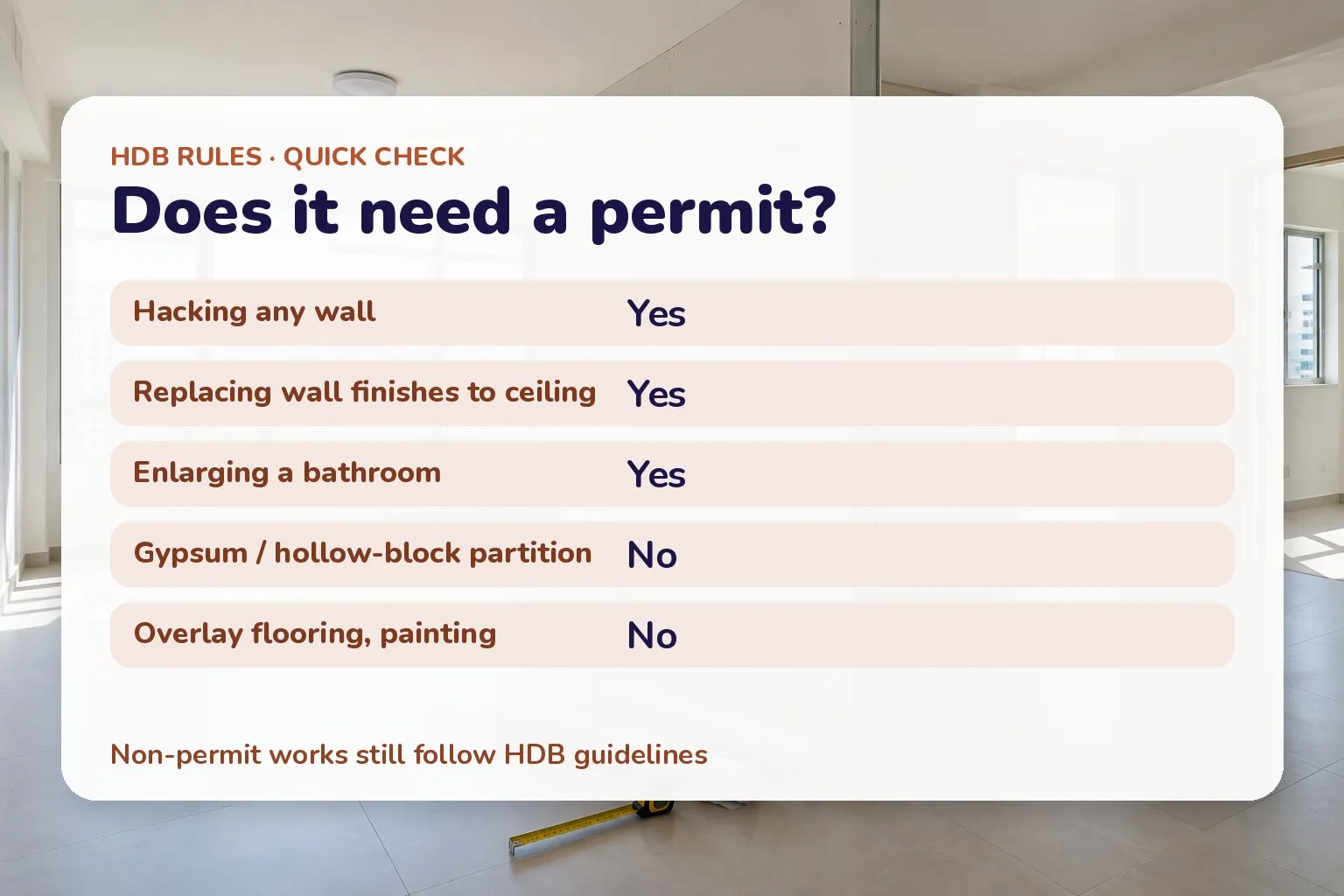
Quick check of common works. Source: HDB Renovation Guidelines for Building Works.
| Work | Permit? |
|---|---|
| Demolishing or hacking any wall (partial or complete) | Yes — prior written approval |
| Demolishing a non-load-bearing RC element | Yes — a Professional Engineer must supervise |
| Replacing internal wall finishes up to ceiling level | Yes |
| Enlarging a bathroom/toilet (after the first 3 years) | Yes |
| Replacing a bathroom/toilet vent | Yes |
| Erecting a 63mm hollow-block or gypsum partition wall | No |
| Laying wall finishes over existing finishes (≤13mm) | No |
| Wallpaper, plastering, painting, overlay flooring | No |
Source: HDB Renovation Guidelines for Building Works.
“No permit” does not mean “no rules”. Non-permit works must still follow HDB’s conditions — for example, fasteners into walls must not exceed 6mm in diameter and 40mm in depth, and floor level must not be raised by more than 50mm.
Works that are banned outright
Some works will never be approved. HDB’s examples of disallowed building works include:
- Hacking or removing structural members — reinforced-concrete walls, columns, beams, slabs and staircases.
- Overloading the floor slab beyond 150kg per square metre.
- Plastering of ceilings.
- Partitioning with combustible or toxic materials (plywood, plastics, asbestos).
- Raising the floor level beyond 50mm (including finishes).
- Painting the external parts of the building or installing fixtures outside the flat.
Demolition and hacking in particular are tightly controlled — see the HDB hacking and wall rules.
How the permit is applied for
Your DRC contractor submits the renovation application to HDB and should only start permit-controlled works once approval is granted. Keep a copy of the approval and its conditions. Deadlines apply: newly completed (BTO) blocks must finish within 3 months, existing blocks within 1 month, and window-only works within 2 weeks of the permit date.
Why the DRC rule matters
Engaging a non-DRC contractor, or breaching the renovation rules (for example, unauthorised hacking), can lead to prosecution and an order to reinstate your flat at your cost. Verifying your contractor’s DRC listing is part of how to choose a renovation firm. Resale flats, which often need hacking and rewiring, are where these rules bite most — see the resale flat renovation cost guide.
Related
General information only, not legal advice. Rules change; confirm the current requirements on the HDB website before you start.
Sources
- Important Information on Renovations — Housing & Development Board (HDB) (as of October 2026)
- Renovation Guidelines for Building Works — Housing & Development Board (HDB) (as of October 2026)
- Directory of Renovation Contractors (DRC) — Housing & Development Board (HDB) (as of October 2026)